Restaurant robots are moving beyond fixed routes and repeated motions. AI lets them read camera and sensor data, choose a response, and adjust when a dining room changes around them. The useful question is how much of that judgment works during a busy service.
Quick read
- Cameras can help robots spot tables, people, trays, spills, and blocked paths
- Task software can send one robot through several steps instead of one fixed motion
- Staff still need to handle safety, unusual objects, and failures
From fixed routes to changing rooms
Older service robots could follow mapped paths and stop when something blocked them. AI can help a robot identify the obstacle, estimate where it is, and choose another route.
That matters in a restaurant because chairs move, customers stand up, and staff cross the same floor with hot food.
The robot needs more than a camera. It may combine images with wheel movement, depth readings, and map data. This process helps it work out whether a dark shape is a chair, a person, or a gap in the floor.
That decision still has limits. Poor lighting, reflective surfaces, crowded aisles, and objects outside the training data can confuse the system. A restaurant manager should treat the robot's response as a tested function, not human-like common sense.
AI in delivery and table service
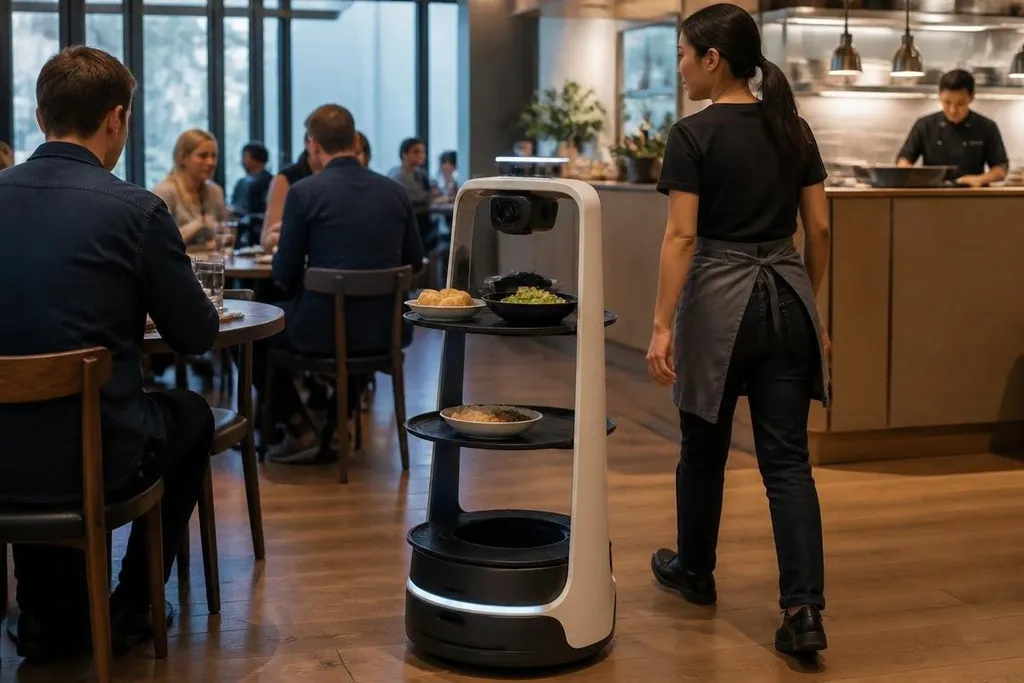
A delivery robot can use AI to link a job to a location, avoid people, and return to a charging point after its work. The software can also change the order of tasks when a table is unavailable or a corridor is blocked.
That can reduce idle movement, but it adds another place where a failure can occur. If the order system, map, or robot software has the wrong table number, the robot may complete its route and still miss the customer.
The handoff creates another test. A robot may reach the right table and still need a person to open a compartment, confirm an order, or deal with a spill. The last step often sits outside the robot's control.
Kitchen robots face conditions the dining room handoff avoids: heat, grease, tight timing, and food-safety rules. For an operator weighing a pilot, reporting at Robot 24 can connect claims about restaurant robots with named machines, makers, test settings, and results. That record shows whether AI handled a real cooking step or only recognized ingredients in a controlled demo.
Kitchen work needs tighter control
AI can help a kitchen robot sort items, check whether a container is in the right place, or adjust a motion when an ingredient shifts. Those tasks depend on repeatable tools, known work areas, and clear safety rules.
Food work also brings problems that a clean lab setup may avoid. Ingredients vary in size and shape. Steam can affect cameras. Grease can cover sensors. A gripper that handles one container well may slip on another with a different surface.
The robot should have a narrow job with a clear pass or fail result. A system that loads one type of tray may be easier to check than one asked to handle every item in a kitchen.
What AI still can't prove
A smooth demonstration shows that a robot completed one recorded task. It doesn't show how often the task fails across a full service, how much staff help it needs, or what happens after a sensor fault.
Those questions affect the cost more than the AI label. A restaurant needs to count setup time, cleaning, charging, repairs, software fees, and staff time spent watching the robot. A cheaper machine can cost more if workers must correct it every few minutes.
I’d skip any restaurant robot whose maker cannot show failure rates, recovery steps, and the limits of its operating area.
A buying check for restaurant managers
Use this list before a pilot:
- Name one task: Set a job with a clear start point, end point, and success test.
- Map the busy period: Run the robot when staff, customers, carts, and chairs share the floor.
- Check human handoffs: Record every step that still needs a worker.
- Test bad inputs: Try blocked paths, low light, misplaced items, and empty trays.
- Count the full cost: Add service work, cleaning, charging, repairs, and software.
- Set a stop rule: Decide when staff should take control of the robot.
That process gives AI a fair test. The next useful proof will be simple: how many restaurant tasks a robot can finish without staff correction, across a full service rather than a short demonstration.